
How to play BlackJack, and use Blackjack Chart
What if I told you that Blackjack is one of the easier table games to learn, and your decisions actually matter!
This guide will teach you the rules, the flow, and give you a chart in the end so you can easily practice for real.

The Basics
Forget everyone else at the table. Your only goal is to beat the dealer. How? By having a hand value closer to 21 than theirs without going over. A Blackjack is an Ace with any 10-value card (e.g., A♠️ + K♦️= 21) and is the best possible starting hand. If you go over 21, you “bust” and lose automatically. It’s that simple.
Card Values
- Number Cards: (2-10): Worth their face value.
- Face Cards: (J, Q, K): Worth 10 each.
- Ace: Worth either 1 or 11, whichever gives you the better hand.
- Suits: ♦️ ♠️ ♥️ ♣️ – They don’t affect the gameplay at all.
Example Hand values:
7♥️ + 3♠️ = 10
J♦️ + 6♣️ = 16
A♠️ + 8♥️ = 19 (or 9)
Quick Glossary
Hit: Take another card.
Stand: Keep your hand.
Bust: Go over 21—you lose.
Blackjack 21 : Ace + 10-value card on your first two cards.
The Flow of the Game
Place Your Bet: Put your chips in the betting circle before the dealer says “No more bets.” You can adjust your bet up or down between hands.
The Deal: Everyone gets two cards. Your cards are dealt face up (in most online casinos) or face down (in some live casinos). The dealer gets one card face up (the “upcard”) and one card face down (the “hole card”).
Your Turn: This is where you make your moves. Your options are:
- Hit: You receive another card. (In a live casino, signal by gently tapping the table behind your cards.)
- Stand: You stop and keep your hand as is. (Signal by waving your hand horizontally over your cards.)
- Double Down: You double your original bet and get exactly one more card. This is a powerful move when you have a strong starting hand (like an 11).
- Split: If your first two cards are a pair (e.g., 8♠️ + 8♥️), you can split them into two separate hands. You place a new bet equal to your original, and now you play two hands against the dealer. Some casinos allow you to double down after splitting and this is called “Double After Split” (DAS). Not all casinos allow it, so check the table rules before sitting down.
- Surrender: (If the table allows it) You can give up your hand and get half your bet back. It’s a strategic retreat when you have a really bad hand, use it wisely.
The Dealer’s Turn: After all players have finished, the dealer reveals their face-down card. Here’s the key: The dealer has no choices. They must follow a strict rule: Hit until they have 17 or higher.
Note: If the dealer has a Soft 17 (Ace + 6), some casinos require them to hit, while others make them stand. This is called S17 vs. H17 and slightly affects the house edge. Always check the table rules before you play!
Winnings, Payouts, and Game Variations
Understanding how you get paid is just as important as knowing how to play. Below is a breakdown of standard payouts, along with a look at how different rules can affect the game.
Standard Payout Rules
| Result | Payout Odds | Explanation |
|---|---|---|
| Player Blackjack | 3:2 | The best hand! An Ace and a 10-value card (10, J, Q, K) on your first two cards. A $10 bet wins you $15 (plus your original $10 back, totaling $25). |
| Winning Hand | 1:1 | You beat the dealer’s hand without a Blackjack. A $10 bet wins you $10 (plus your original $10 back, totaling $20). |
| Push (Tie) | N/A | Your hand and the dealer’s hand have the same value. Your bet is returned to you—no win, no loss. |
| Insurance | 2:1 | A side bet offered when the dealer’s upcard is an Ace. If the dealer has Blackjack, this bet pays 2:1. |
How Game Rules Affect RTP
Different rules spice up the gameplay and directly affect the payout. The most impactful stat is RTP (Return to Player)—the higher the percentage, the better for you. Additionally, the table below shows some of the most popular variations and their RTP ranges.
| Variation | Key Rules & Features | RTP Range |
|---|---|---|
| Classic Blackjack | Standard 52-card deck. Pays 3:2 on Blackjack. A solid, reliable choice for beginners. | ~99.5% |
| Atlantic City Blackjack | 8 decks. Dealer stands on soft 17. Allows double down after splitting and late surrender. Player-friendly rules give it one of the lowest house edges. | ~99.65% |
| European Blackjack | 2 decks. Dealer doesn’t take a hole card until after you act, which increases risk slightly. Good for classic rules fans. | ~99.34% |
| Single Deck Blackjack | Shuffled after every round. Rules vary—watch out for 6:5 Blackjack payouts, which significantly lower the RTP. | ~98.76% |
| Spanish 21 | Uses a Spanish deck (all 10s removed). Offers bonuses for 5-card hands. Complex and popular with experienced players. | ~99%+ |
| Blackjack Switch | You’re dealt two hands and can switch the second card between them. Unique strategy required. | ~99.3-99.42% |
Why Deck Size Matters
Furthermore, the number of decks used in a game directly affects the house edge. In general, fewer decks are (usually) better for the player. However, casinos often compensate for this by adjusting other rules—for instance, paying 6:5 on Blackjack instead of 3:2.
Key Table Rules to Look For:
Late Surrender offered (lets you fold a terrible hand and lose only half your bet, after the dealer checks for Blackjack)
“Blackjack pays 3:2” (avoid 6:5 tables—it hurts your odds)
Dealer Stands on Soft 17 (S17) (better for you than H17)
DAS (Double After Split) allowed (gives you more flexibility)
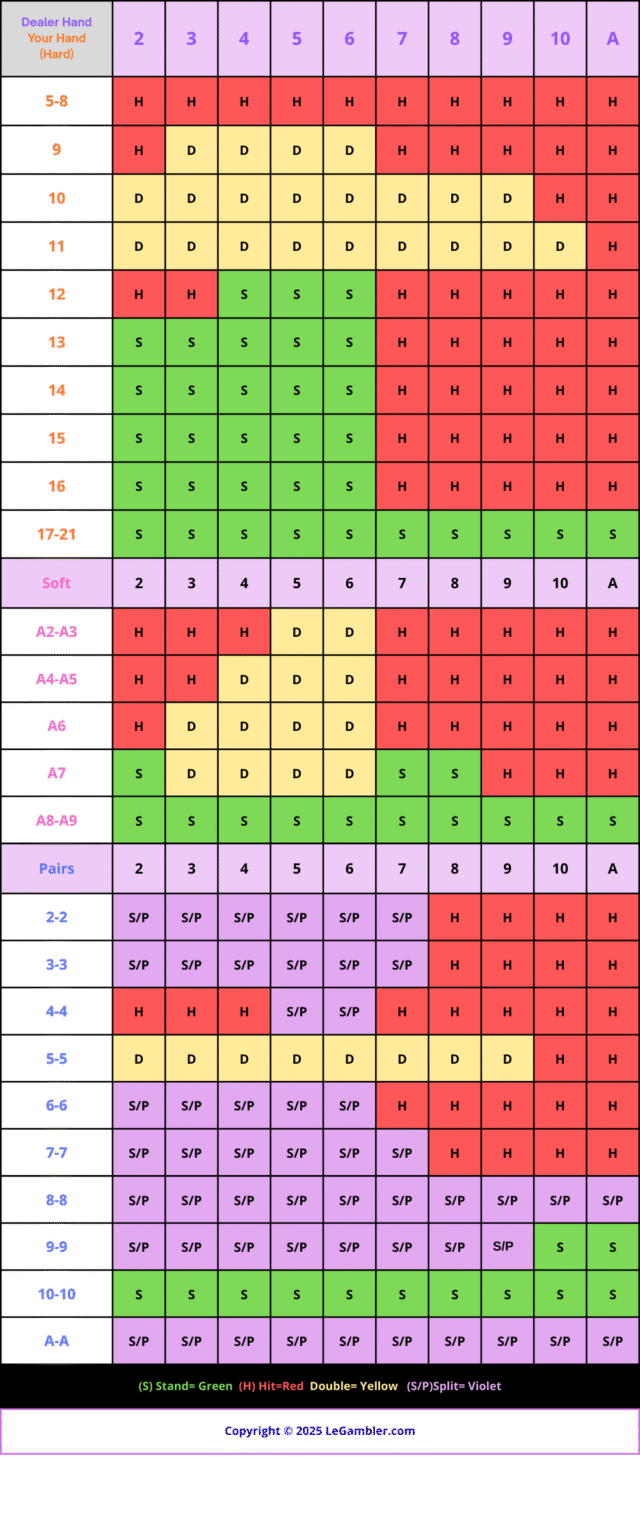
The Basic Strategy Chart
Practicing with a chart helps you learn optimal play and reduce the casino’s edge.
How to Use This Chart:
- Find your hand value on the left.
- Find the dealer’s upcard along the top.
- Find where they meet, that’s your play!
Actions:
- H = Hit
- S = Stand
- D = Double Down
- SP = Split
You’re Ready to Play! Good luck!
Remember the chart isn’t a guarantee. It’s math.


Daily, Weekly and Monthly Bonuses. VIP Program with cash milestones, even its own Lottery. 18+ T&Cs apply.